'%20stroke-width='2.06905'/%3e%3cpath%20d='M11.8693%2013.0529L34.8478%2010.9912L5.66088%204.90687M11.8693%2013.0529L16.4275%2029.5866L11.1288%2025.2477M11.8693%2013.0529L5.66088%204.90687M5.66088%204.90687L3.70953%2030.1002L11.1288%2025.2477M5.66088%204.90687L11.1288%2025.2477'%20stroke='url(%23paint1_linear_logo_mark)'%20stroke-width='2.06905'/%3e%3cdefs%3e%3clinearGradient%20id='paint0_linear_logo_mark'%20x1='31.1877'%20y1='15.4705'%20x2='15.2677'%20y2='22.1691'%20gradientUnits='userSpaceOnUse'%3e%3cstop%20stop-color='%2300FFD2'/%3e%3cstop%20offset='1'%20stop-color='%23114239'/%3e%3c/linearGradient%3e%3clinearGradient%20id='paint1_linear_logo_mark'%20x1='15.438'%20y1='10.5337'%20x2='25.1816'%20y2='22.396'%20gradientUnits='userSpaceOnUse'%3e%3cstop%20stop-color='%2392CEC0'/%3e%3cstop%20offset='1'%20stop-color='white'/%3e%3c/linearGradient%3e%3c/defs%3e%3c/svg%3e)

Field notes
A useful part deserves a second life.
Spare parts become valuable again when their condition, context, and potential are made legible.
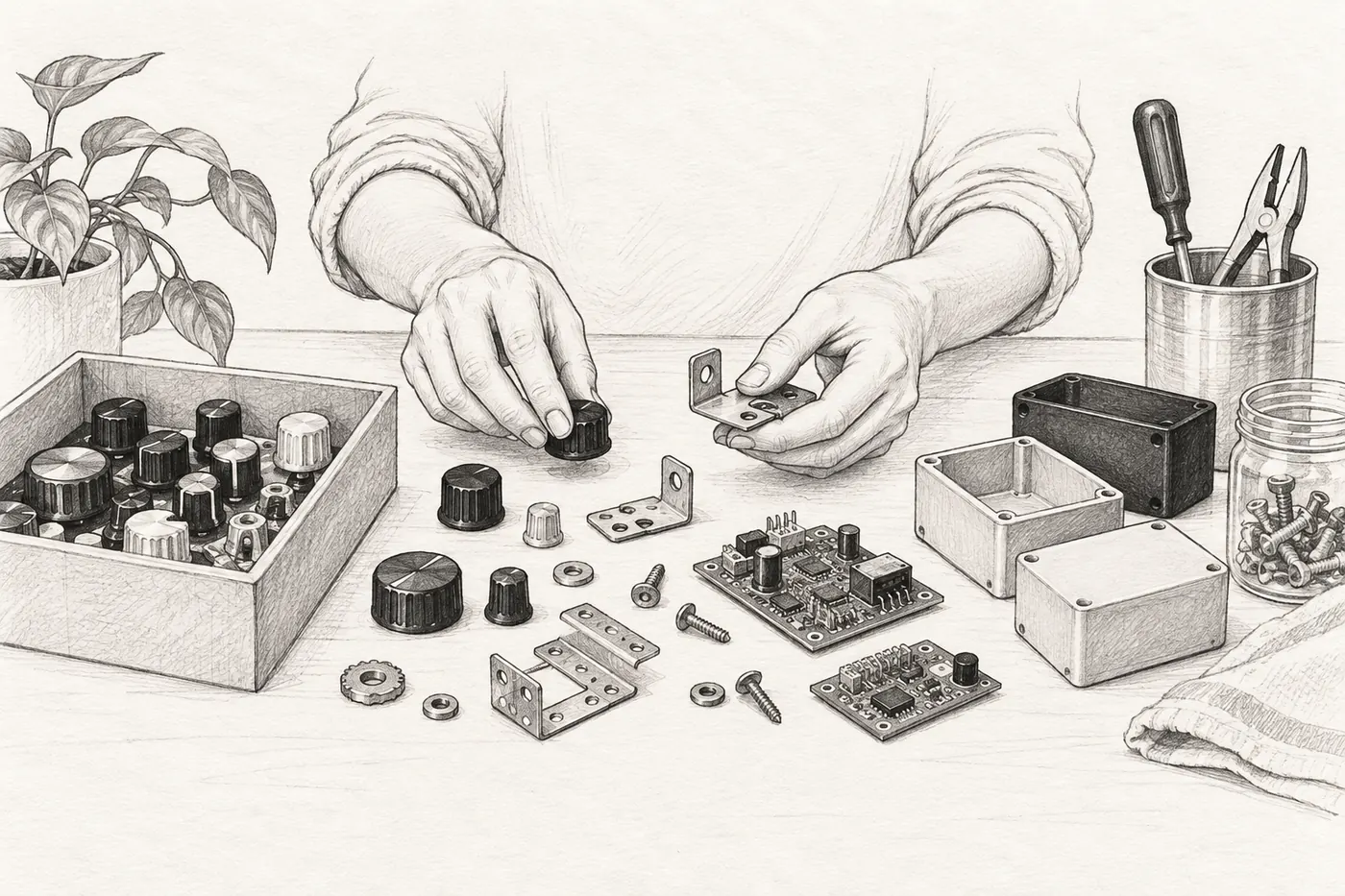
A workshop slowly gathers a quiet inventory. There are switches left after a redesign, motors from an abandoned prototype, displays ordered in the wrong size, and perfectly good fasteners that no longer belong to an active build. Each part is too useful to discard and too poorly described to use.
The obstacle is rarely the part alone. It is missing context. Without a clear identity, condition, and reason to trust it, a component becomes a question someone else must spend time answering. Giving a part a second life starts by reducing that uncertainty.
Make the part legible
Begin with what can be observed and verified. Record the manufacturer marking or exact model when available, the quantity, major dimensions, and connector or mounting details. Say whether it is unused surplus, removed from a working assembly, or untested. These are different conditions, and plain language serves the next maker better than an optimistic label.
“A spare becomes useful when another maker can understand it without inheriting your guesswork.”
A few deliberate photographs can carry much of the remaining context. Show the whole part, its markings, its connectors, and any wear. Include a sense of scale. If there are several units, show the actual group rather than a representative catalogue image. The goal is not glamour; it is a confident decision.
Preserve the small pieces of knowledge
Parts often arrive with knowledge that never made it into a formal specification. A bracket was made to fit a common extrusion. A display needs an unusual cutout. A knob clears one shaft but not another. Write down what you learned while using it, while keeping observation separate from assumption.
- Keep labels, matching cables, and known accessories with the part.
- Add a short note about the project and environment it came from.
- Package small items so markings and delicate features stay readable.
- Update the record if you test, divide, or reserve the quantity.
Design with recovery in mind
Second lives are easier when the original product allows parts to leave gracefully. Standard fasteners, accessible assemblies, replaceable wear parts, and visible revision marks all help. So does keeping a modest service record. These choices support repair today and make components easier to recover when the larger object eventually changes purpose.
This does not mean every fragment must be saved indefinitely. Sorting is an act of judgment. Some parts lack a sensible path back to use, and clutter can hide the good material. Set a clear space for surplus, review it periodically, and describe promising items while their history is still fresh.
A component moving from one bench to another is a small form of continuity. It shortens someone’s search and lets existing material answer a new problem. The practical work is simple: identify it, tell the truth about it, preserve what you know, and make the handoff easy.