'%20stroke-width='2.06905'/%3e%3cpath%20d='M11.8693%2013.0529L34.8478%2010.9912L5.66088%204.90687M11.8693%2013.0529L16.4275%2029.5866L11.1288%2025.2477M11.8693%2013.0529L5.66088%204.90687M5.66088%204.90687L3.70953%2030.1002L11.1288%2025.2477M5.66088%204.90687L11.1288%2025.2477'%20stroke='url(%23paint1_linear_logo_mark)'%20stroke-width='2.06905'/%3e%3cdefs%3e%3clinearGradient%20id='paint0_linear_logo_mark'%20x1='31.1877'%20y1='15.4705'%20x2='15.2677'%20y2='22.1691'%20gradientUnits='userSpaceOnUse'%3e%3cstop%20stop-color='%2300FFD2'/%3e%3cstop%20offset='1'%20stop-color='%23114239'/%3e%3c/linearGradient%3e%3clinearGradient%20id='paint1_linear_logo_mark'%20x1='15.438'%20y1='10.5337'%20x2='25.1816'%20y2='22.396'%20gradientUnits='userSpaceOnUse'%3e%3cstop%20stop-color='%2392CEC0'/%3e%3cstop%20offset='1'%20stop-color='white'/%3e%3c/linearGradient%3e%3c/defs%3e%3c/svg%3e)

Perspectives
India needs a home for the hardware that isn't for everyone.
A seller account is useful. A place to find your people, figure out what to build, and keep improving it is a different thing.
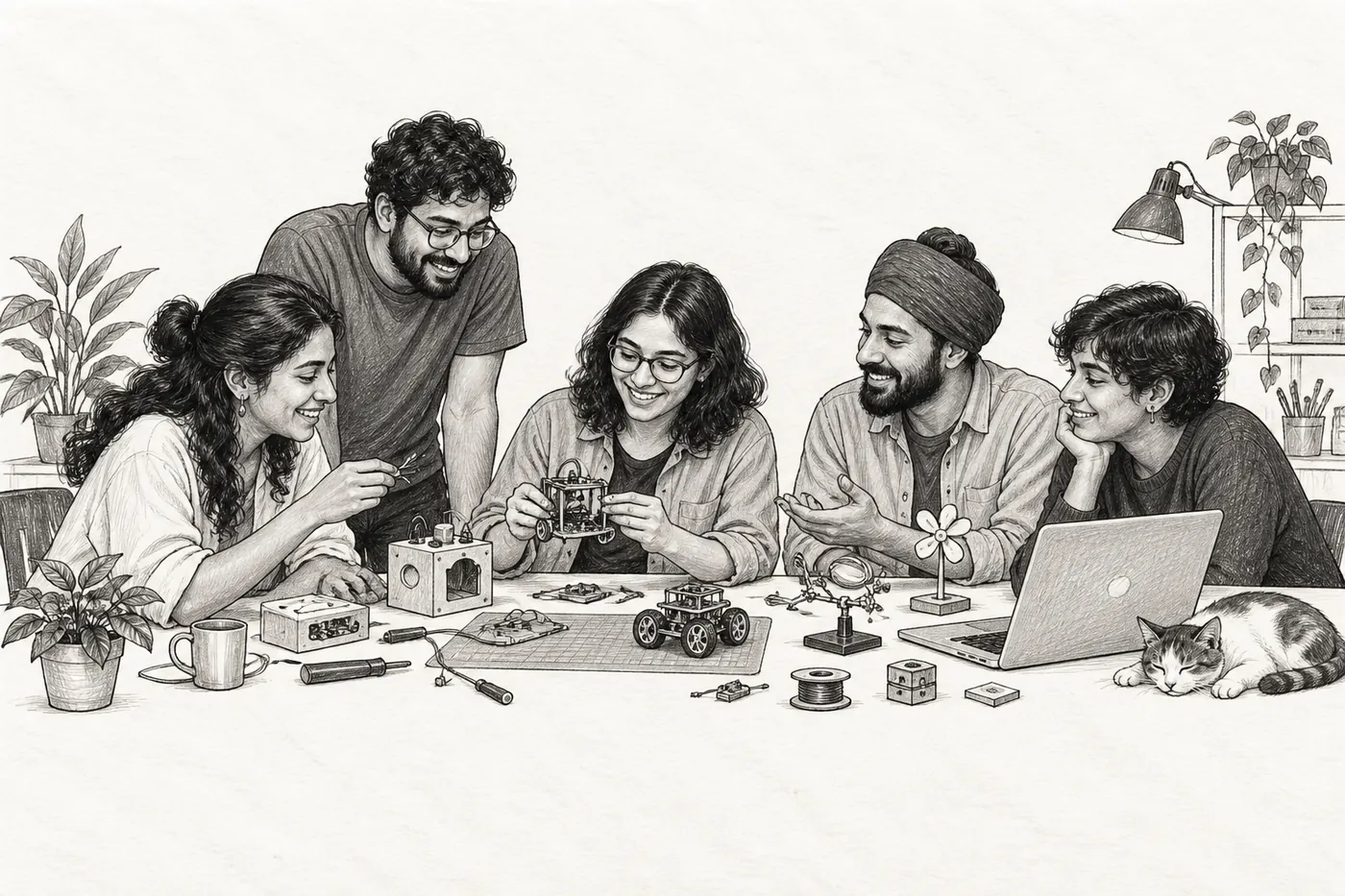
You build a thing. It solves a weirdly specific problem. You show it to a few people and one of them goes, “Wait, I need that.” Then you hit the awkward bit: where does this thing actually belong?
Maybe it's a little desk device. A controller for one particular hobby. A better enclosure for a board people already use. It doesn't need to become the next big consumer brand to be worth making. It needs to reach the people who get it. That's the bit we want Selfcrafted to care about, here in India.
“Why not just sell on Amazon?”
Fair question. Amazon has a seller registration route, and Robu has a seller enquiry form. Those doors exist. We're not pretending otherwise. If you've got a finished product and need somewhere to sell it, they're routes you can look into.
Our experience with Lornode was a bit less encouraging. We reached out to Robu about getting onboarded and got no response. I wondered whether their own products were part of the reason, but I couldn't verify that. The experience I can actually speak to is the unanswered outreach.
That's just our experience. It did make a very practical question harder to shake, though: why should an independent product's next step depend so much on whether someone else's catalogue has room for it?
Even a successful listing leaves another question open. What if you're still working out the product? Who wants the smaller version? Is that extra feature useful, or just something you enjoyed adding? Who will try the awkward first revision and tell you what needs fixing? A place to sell the answer isn't automatically a place to work out the question.
Niche is an audience, not a unit count
Imagine a graph. One axis is how broad the audience is. The other is how many units they need. People tend to squash those into the same thing: small audience, small opportunity. But they don't always travel together.
A small hobby community might want a handful of a very particular accessory. A narrow type of business might need that same kind of specialised object over and over. Both audiences are niche. One needs a small batch; the other could need a much bigger one. Neither has to appeal to absolutely everyone.
“A small audience can still have a very real need. The batch size is a separate conversation.”
That's the part of the graph we're interested in. Consumer and hobbyist hardware with a clear reason to exist, whether the right quantity is modest or surprisingly large. We don't want a project to have to cosplay as a mass-market startup just to be taken seriously.
Make the figuring-it-out part fun
This is where the gamification idea comes in. We'd like product research and development to feel like something people can join. You discover a project, react to an early direction, help the maker understand a problem, and get to see what changed because people cared enough to contribute.
Think visible progress, useful little milestones, and reasons to come back as an idea gets better. The interesting achievement is a better product, or a clearer understanding of what people need. A pile of clicks with nothing learned doesn't do much for anyone. We're still figuring out how to make that participation feel rewarding without turning it into noise.
And the consumer belongs in that process. You shouldn't need to design a circuit board to say, “This would be perfect if I could use it one-handed.” Hobbyists, buyers and makers notice different things. Getting them into the same conversation, while changes are still possible, is the whole point.
Why we keep coming back to a platform of our own
Sure, you can stitch together a shop, a chat group, a feedback form and a long trail of DMs. People make that work. But somebody has to keep carrying the context between all those places. The customer sees a listing. The maker sees a dozen scattered requests. The story of how the thing got better gets lost somewhere in the middle.
For what we're trying to do, adding another seller account doesn't really solve it. We want discovery, development and the eventual product to stay connected. We want a maker in India to have somewhere to start before the product looks like an obvious retail bet, and somewhere to stay if the audience remains small and specific.
That's the case for Selfcrafted. It's an attempt, not a victory lap. We still have to earn the attention of the people we want to serve, and the more playful R&D experience is a direction we're working towards. But the thing we're building around is pretty simple: if something is really useful to the right people, it deserves a fair shot at existing.