'%20stroke-width='2.06905'/%3e%3cpath%20d='M11.8693%2013.0529L34.8478%2010.9912L5.66088%204.90687M11.8693%2013.0529L16.4275%2029.5866L11.1288%2025.2477M11.8693%2013.0529L5.66088%204.90687M5.66088%204.90687L3.70953%2030.1002L11.1288%2025.2477M5.66088%204.90687L11.1288%2025.2477'%20stroke='url(%23paint1_linear_logo_mark)'%20stroke-width='2.06905'/%3e%3cdefs%3e%3clinearGradient%20id='paint0_linear_logo_mark'%20x1='31.1877'%20y1='15.4705'%20x2='15.2677'%20y2='22.1691'%20gradientUnits='userSpaceOnUse'%3e%3cstop%20stop-color='%2300FFD2'/%3e%3cstop%20offset='1'%20stop-color='%23114239'/%3e%3c/linearGradient%3e%3clinearGradient%20id='paint1_linear_logo_mark'%20x1='15.438'%20y1='10.5337'%20x2='25.1816'%20y2='22.396'%20gradientUnits='userSpaceOnUse'%3e%3cstop%20stop-color='%2392CEC0'/%3e%3cstop%20offset='1'%20stop-color='white'/%3e%3c/linearGradient%3e%3c/defs%3e%3c/svg%3e)

Perspectives
The best hardware starts with a small, stubborn problem.
A useful product often begins with one ordinary frustration that refuses to go away.
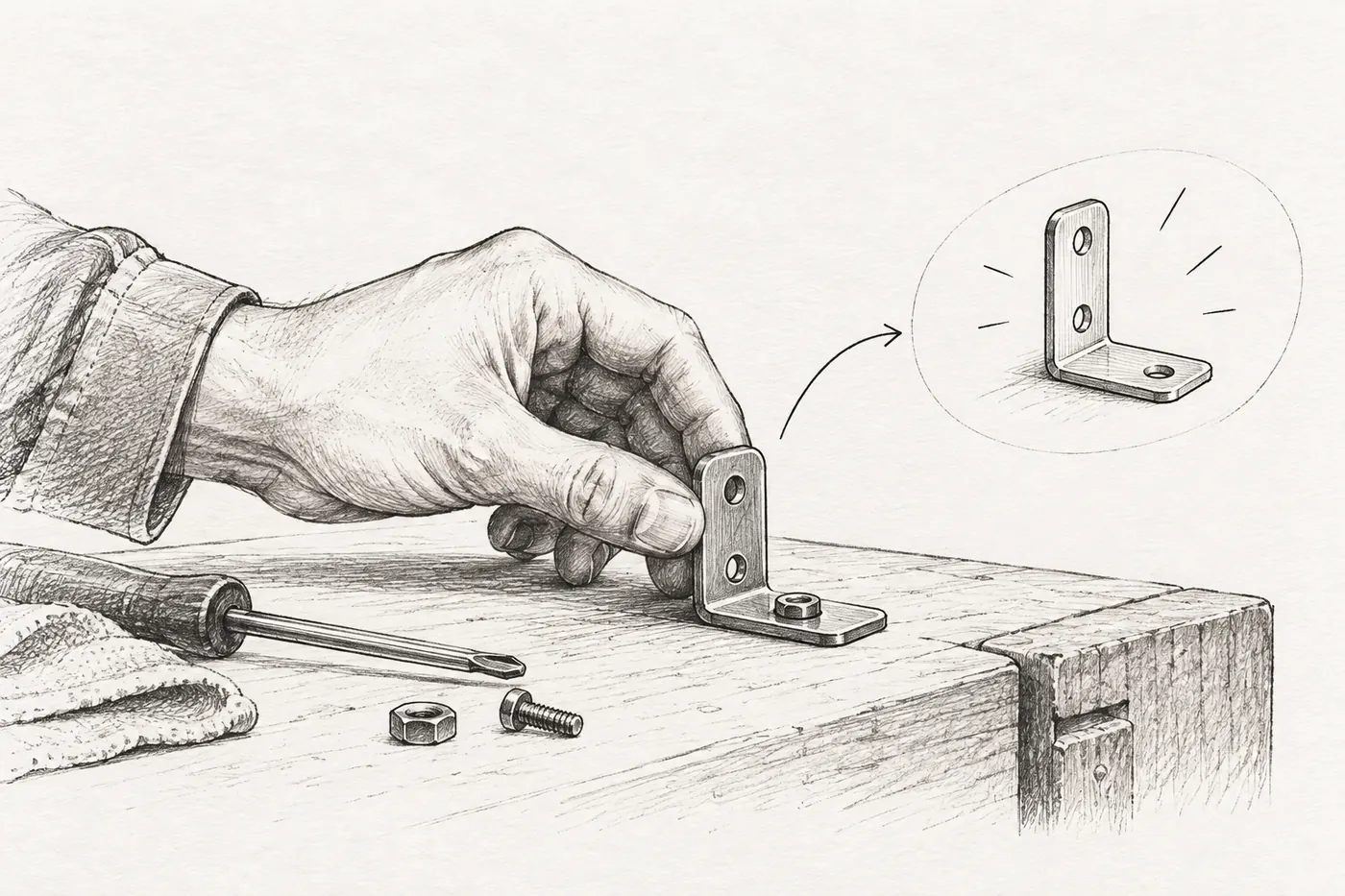
Hardware ideas are often introduced at their largest scale: a platform, an ecosystem, a new category. The work usually begins somewhere much smaller. A connector is awkward to reach. A tool has nowhere sensible to sit. A common enclosure almost fits, but wastes the space that matters. The problem is modest enough to ignore and persistent enough that somebody eventually decides not to.
That small beginning is useful because it gives the maker a sharp test. The object either improves a real moment or it does not. There is less room for a vague promise when a prototype must fit a hand, a desk, or another part. The physical world keeps the brief honest.
Stay close to the irritation
Before choosing features, describe the troublesome moment precisely. What is someone trying to do? What interrupts them? What workaround have they already invented? A taped-on spacer or hand-labelled switch is not an embarrassment. It is evidence that the need has survived contact with daily life.
“A narrow problem gives each design decision somewhere solid to stand.”
A clear problem also helps with restraint. If a display, wireless connection, or companion app does not improve that moment, it can wait. Every addition asks for space, power, assembly time, documentation, and support. A simple object can still be ambitious; its ambition is to remove friction reliably.
Build the smallest complete answer
The first useful version should form a complete loop. A mount should mount securely and release when expected. A controller should make its essential state legible. A small instrument should produce a result that its user can understand. “Complete” does not mean polished or final. It means the central promise can be tested without explaining away missing pieces.
- Name the one action the object must make easier.
- List the constraints the physical setting imposes.
- Remove any feature that cannot yet justify its cost and complexity.
- Put the result in the place where the problem actually happens.
Once the core works, the surrounding product becomes easier to see. Repeated use reveals which edge needs softening, which label is unclear, and which step belongs in the instructions. Those details are discovered through attention, not guessed in a feature list.
Let usefulness set the scale
Some stubborn problems belong to a small group, and that can be enough. Indie hardware does not need to imitate the scale of mass-market electronics to matter. A carefully made part can serve a particular workflow, repair a familiar annoyance, or keep another object in use. Its value comes from the quality of the fit between problem and answer.
The maker can always widen the view later. Variants, accessories, and new uses may emerge. Starting narrow simply means the first claim is one you can inspect, build, and improve. Find the small problem that keeps asking for attention. Give it a direct answer. That is enough ground for good hardware to begin.